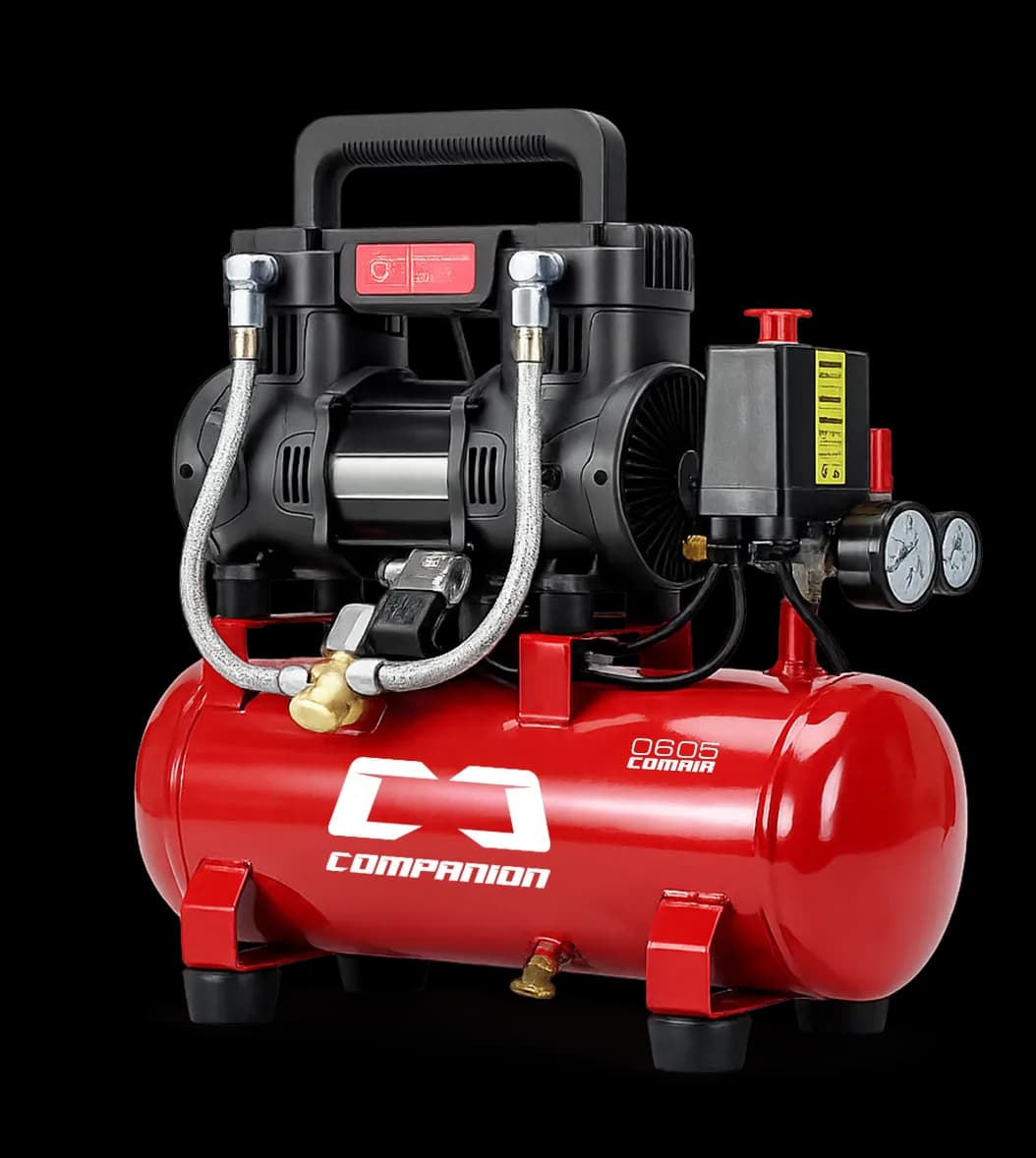
It is not about the motor, it is about flow
People buy compressors by horsepower and tank litres. What actually decides whether your tool works is flow, measured in litres per minute (L/min) or CFM. If your tool asks for more air than the compressor delivers, you will work in fits and starts: the motor never stops, pressure drops and the finish suffers.
Rule of thumb: add up the consumption of the tools you will run at the same time and add a 30% margin. Our air calculator does it for you.
Typical consumption at 6.2 bar
| Tool | Approximate consumption |
|---|---|
| Tyre inflator | 60 L/min |
| Impact wrench 1/2" | 115 L/min |
| Air grinder | 140 L/min |
| Orbital sander | 170 L/min |
| HVLP spray gun | 280 L/min |
The sander and the spray gun are what kill a small compressor: they draw a lot, and continuously rather than in bursts.
Pressure is rarely the problem
Almost all air tools work at 6.2 bar (90 psi). Any decent compressor reaches 8 bar. Only look at pressure if you plan to run something special, such as a large riveter or heavy shop equipment.
The tank buys time, not flow
A big tank does not make more air: it lets you work longer before the motor has to kick in. For burst use, a big tank hides a tight flow figure. For continuous use it will not save you: you need flow.
Quick guide:
- Home and occasional use: 24 to 50 L
- Small one-person shop: 50 to 100 L
- Body and paint or several users: 100 L and up
Oil-free or lubricated
Oil-free units need no oil maintenance, start and work, and keep the air clean. They are the logical choice for paint, food, clinics and clean workshops. Lubricated units handle very long shifts better and are usually quieter thanks to lower rpm, at the cost of servicing.
The three mistakes everyone makes
- Buying by horsepower. Two 3 HP compressors can deliver very different flows. Look at L/min.
- Forgetting the installation. A thin or very long hose eats your pressure. Use 10 mm hose for demanding tools.
- Never draining the tank. Condensed water rusts the tank from inside. Drain it weekly, it takes a minute.
Before you decide
List the tools you will really use, not the ones you might use one day. If torn between two, take the one with more flow: nobody ever regretted having spare air.